Do I Need a Social and Ethics Committee?
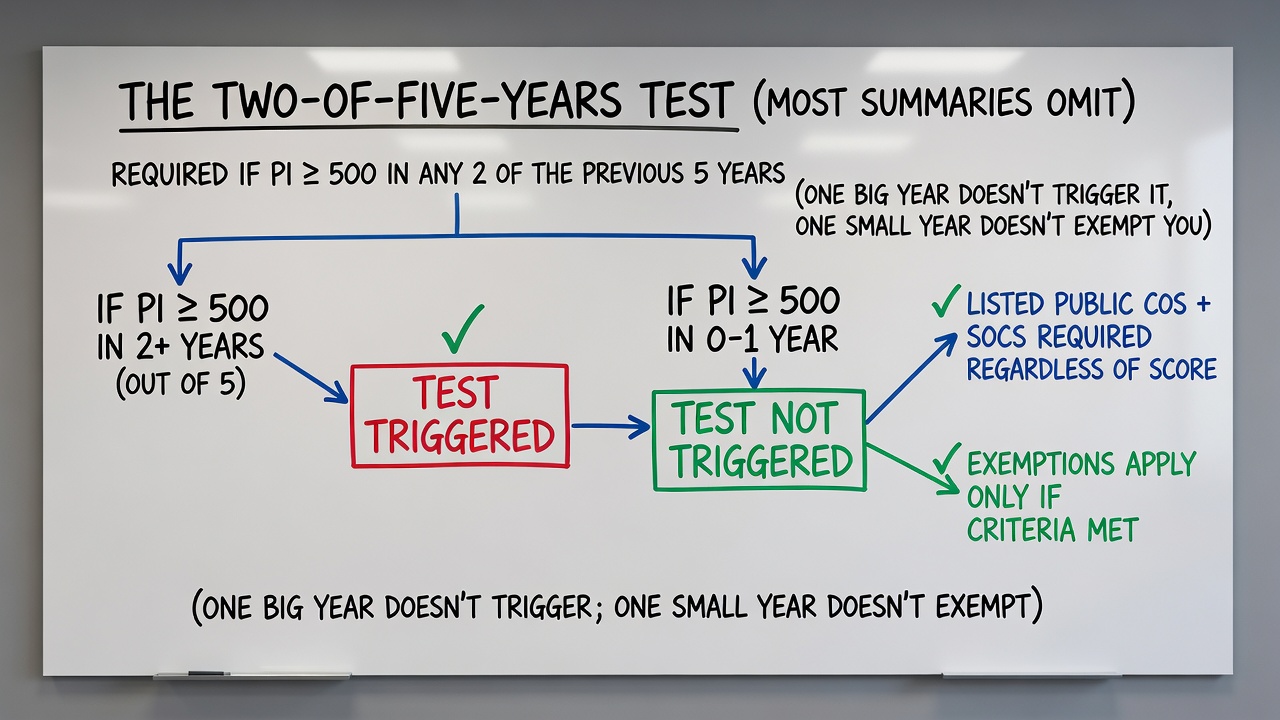
The two-of-five-years test most summaries omit: required if PI >=500 in ANY 2 of the previous 5 years (one big year doesn't trigger it, one small year doesn't exempt you); plus listed public cos + SOCs required regardless of score.
Every South African company director faces the same question eventually: are we large enough to need a Social and Ethics Committee? Most resources give you a simple answer: if you have more than 500 employees, yes. But that's only half the story—and it could cost you dearly if you get it wrong.
The honest answer involves a test that most compliance checklists omit entirely. It's called the two-of-five-years test, and it changes everything about who must actually have an SEC.
What the Law Actually Says
The Companies Act, 71 of 2008 (Section 72(4)) and the Companies Regulations, 2011 (Regulation 43(1)) set out three separate triggers for appointing a Social and Ethics Committee. The first two are absolute: if you're a listed public company or a state-owned company, you must have an SEC regardless of your Public Interest (PI) score.
The third trigger is where confusion sets in. For all other companies, the rule is based on your PI score—but not in the way most people think.
The PI Score Threshold: One Big Year Doesn't Trigger It
Your Public Interest score is a composite measure based on five factors: the number of employees, revenue, market capitalisation, number of beneficiaries affected, and economic significance. When you score above 500 on this metric, you enter the range where an SEC might be required.
But here's what most summaries miss: you don't need an SEC because you scored 500 in one year. You need one because you scored 500 or above in any two of the previous five years.
This distinction matters enormously. A company that had a big year last year—perhaps through a major contract, an acquisition, or seasonal employment—will not automatically cross into SEC territory. Conversely, a company that has maintained a steady score of 300 will not escape the obligation simply because this year's score dropped below 500.
The five-year lookback period is your window. If your PI score has been 500 or above in any two of those five years, you are required to appoint a Social and Ethics Committee.
Who Must Have an SEC: Three Clear Rules
- Listed public companies on any exchange must appoint an SEC, regardless of PI score.
- State-owned companies must appoint an SEC, regardless of PI score.
- All other companies must appoint an SEC if their PI score has been 500 or above in any two of the previous five years.
That third rule is the one most companies get wrong. They measure their current year and make a decision in isolation. By law, you need to look back across five years and count how many times you've hit the threshold. Understanding these requirements is essential, which is why many companies turn to a comprehensive whistleblowing and compliance solution to help manage their governance obligations effectively.
Why the Five-Year Test Matters
The five-year lookback serves an important purpose: it prevents companies from yo-yoing in and out of compliance based on a single large contract or a temporary spike in headcount. It also means that a single difficult year—where you drop below 500—does not immediately exempt you from your obligations.
If you've been running at 520 employees for four years and you drop to 480 in year five, you remain subject to the SEC requirement because you've already triggered the two-of-five test. The threshold is not "you must stay above 500 every year." It's "you must have been above 500 in at least two of the past five years."
This is precisely the test that most compliance checklists omit, perhaps because it requires companies to track their own history rather than simply check a single data point.
Good Practice Beyond the Legal Threshold
The legal obligation is clear: SEC or not SEC, based on those three rules above. But the threshold itself is the floor, not the ceiling.
Many companies significantly below the PI 500 mark have chosen to establish ethics, governance, or wellbeing committees voluntarily. They do so because the functions an SEC performs—monitoring ethical performance, overseeing risk, receiving reports on misconduct—are valuable at any scale.
If your organisation has internal whistleblowing channels (as required by the EU Whistleblowing Directive 2019/1937 for organisations with 50 or more employees), having a governance body to review those reports and trends is sound practice, even if you're not legally obliged to have an SEC. The Directive requires you to acknowledge reports within 7 days and provide feedback within 3 months (Article 8 and Article 9). A formal SEC or ethics committee provides the structure needed to meet these timelines consistently. For a detailed overview of your regulatory obligations, review our complete regulatory guide for UK, EU, and South Africa to ensure your governance framework aligns with all applicable requirements.
Consider also whether your industry faces heightened scrutiny on ethical matters—environmental impact, labour practices, product safety, or community benefit. In these sectors, a proactive SEC demonstrates commitment to stakeholders even before the law requires it. You may also wish to consult our whistleblowing compliance checklist to verify all governance and reporting requirements across your jurisdiction.
Frequently Asked Questions
What counts toward my Public Interest score?
Your PI score is calculated using five factors: (1) the number of employees, (2) revenue, (3) market capitalisation, (4) the number of beneficiaries or stakeholders affected by your business, and (5) your economic significance. Each factor is weighted, and the total determines whether you fall above or below the threshold of 500.
If my PI score was above 500 three years ago but is now 300, do I still need an SEC?
Yes. The two-of-five-years test counts any two occurrences in the past five years, not the most recent year. If your score hit 500 or above at any point in the previous five years, and you've crossed that threshold at least twice in that period, the SEC appointment remains mandatory. A company cannot retroactively "opt out" by dropping below the threshold.
Do listed companies on a foreign exchange have to appoint an SEC?
If the listed company is incorporated or domiciled in South Africa, yes. The Companies Act applies to South African companies. A South African company listed on the JSE, or a South African company listed on any exchange, must appoint an SEC. Foreign-listed companies operating in South Africa may have separate obligations depending on local incorporation and regulatory status.
What happens if we don't appoint an SEC when legally required?
Failure to appoint a Social and Ethics Committee when required constitutes a breach of the Companies Act. Directors may face personal liability, and the company may incur penalties. Regulators and auditors routinely check SEC compliance, and the omission is difficult to hide. Non-compliance can also affect credit ratings, investor confidence, and your ability to tender for public contracts.
Can a small committee handle SEC functions alongside other governance roles?
Yes. The SEC does not have to be a large, separate body. Many smaller companies embed SEC functions within an existing audit, risk, or governance committee, provided the required mandate and reporting structure are in place. However, the committee must have documented terms of reference, regular meeting cadence (typically quarterly or biannual), and a clear reporting line to the Board.