How to Handle an Anonymous Complaint: Avoiding the Two Mistakes That Cost You Most
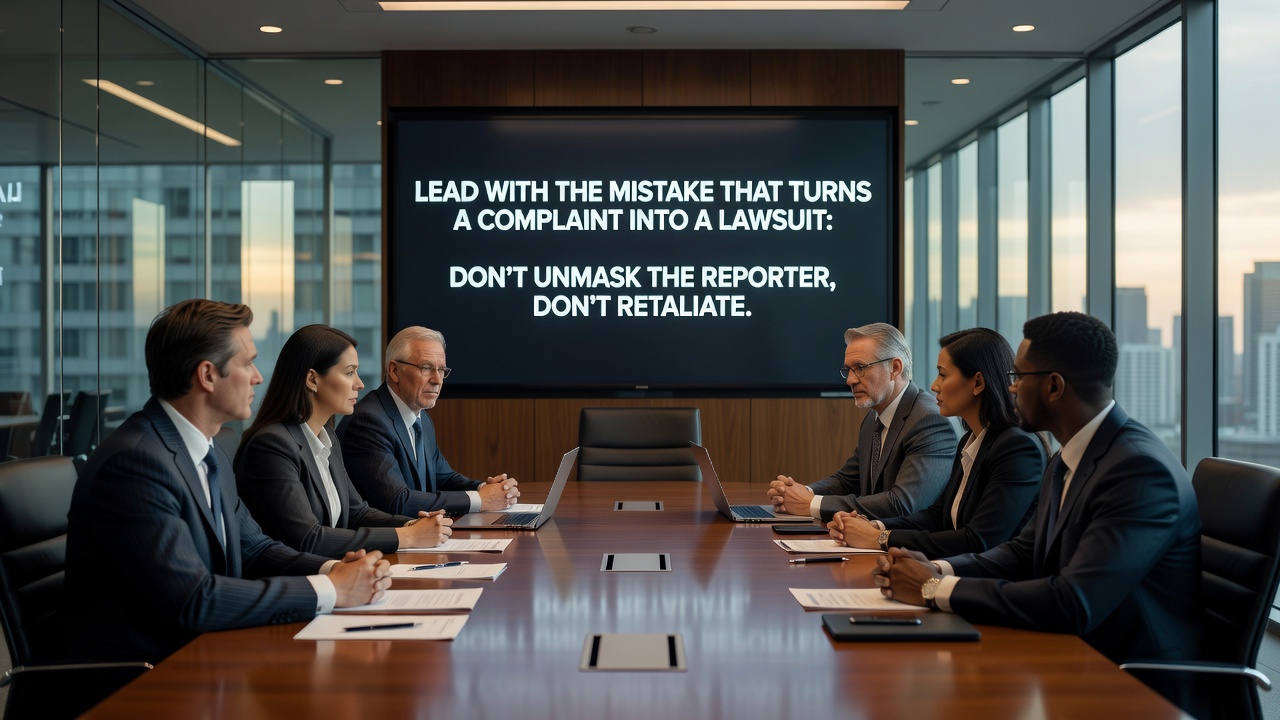
Lead with the mistake that turns a complaint into a lawsuit: don't unmask the reporter, don't retaliate
An anonymous complaint lands in your system. Your instinct is to find out who made it. Your next instinct is to address the behaviour or culture that prompted it. Both instincts can destroy your organisation's legal standing and your culture in one move. The two mistakes that transform a complaint into a lawsuit are: unmasking the reporter and retaliating against anyone involved. This guide explains how to avoid them both, grounded in the EU Whistleblowing Directive 2019/1937 and the legal landscape it created.
Why anonymity matters more than you think
The EU Whistleblowing Directive (2019/1937) exists because reporting wrongdoing carries real risk. People fear job loss, ostracism, and reputational harm. Without genuine protection, they stay silent. Wrongdoing continues. Organisations suffer.
The Directive requires organisations with 50 or more employees to establish an internal reporting channel (Article 8). This channel must allow reports to be made anonymously. This is not optional. It is not a nice-to-have. It is a legal obligation that has been transposed into national law across the EU.
When someone chooses to report anonymously through your formal channel, they are trusting your organisation to keep that trust. Breaking it is not just poor culture. It is a breach of law.
The first mistake: trying to unmask the reporter
Your compliance team receives a detailed allegation of financial misconduct. The account is specific. It names names. It references dates and transactions. Someone in your finance department clearly knows what happened.
The temptation is immediate: find out who it is so you can corroborate their story, assess their credibility, or work with them directly on next steps.
This is where many organisations slip into illegality.
The Whistleblowing Directive protects the confidentiality of reporters. Member States must ensure that national laws and procedures protect persons reporting breaches from retaliation and protect their identity (Article 8). The Directive also states that reporting channels must be designed and operated in such a way as to ensure the confidentiality of the identity of the reporting person (Article 8).
Your national transposition of this Directive—whether that is the Public Interest Disclosure Act 1998 in the UK (which preceded the Directive), national legislation in Ireland, Germany, France, or elsewhere—forbids you from using the information in the report to reverse-engineer the reporter's identity.
This is easier said than done. In a small finance team, a report that references a specific conversation and a specific date might point to one person. That is not your problem to solve by process of elimination.
What you must do instead: treat the report as credible regardless of anonymity. Investigate the allegation, not the reporter. If the facts check out, the source's identity becomes irrelevant. If they do not, the anonymity means you cannot discount the report because you think the reporter is unreliable.
The second mistake: retaliation
Retaliation is the most dangerous mistake because it rarely looks like retaliation to the person committing it.
When an anonymous report lands, you must identify what happened and who was involved. That investigation may point to a specific individual or team. You may need to discipline, demote, or dismiss someone. This is not retaliation. This is accountability.
Retaliation is when you or your team take action against someone because you suspect or know they made the report. It is also when you punish someone for cooperating with an investigation into a report they did not make.
The Whistleblowing Directive requires that Member States ensure that persons reporting breaches… are protected against retaliation (Article 8). Protection against retaliation includes protection of employment relationships and working conditions. Retaliation includes suspension, lay-off, demotion, salary reduction, change of duties, reduction of opportunities for training and promotion, suspension of performance appraisal, or transfer.
The distinction is crucial: investigating wrongdoing and acting on what you find is lawful. Taking any adverse action against someone because they reported it—or because you think they did—is not.
In practice, this means:
- You must document the investigation thoroughly and separately from the report. Your investigation notes should record what was found, how it was found, and what evidence supports each conclusion. They should not reference the anonymous report as the reason you started investigating, even if that is the truth.
- You cannot single out or question individuals because they are suspected reporters or persons of interest in your investigation without credible, documented reasons unrelated to the report itself.
- Any disciplinary action must be grounded in findings of misconduct based on the investigation, not on suspicion of who reported the matter.
- You must ensure that the investigation process itself is fair and consistent with how you would treat any similar allegation, whether anonymous or not.
How to investigate an anonymous complaint properly
The goal of your investigation is simple: establish whether the allegation is true. Your process should reflect that.
Separate the complaint from the investigation. Create distinct files: one for the original complaint (kept confidential) and one for the investigation findings. Your investigation file should stand alone. Someone reading only the investigation file should not be able to deduce that an anonymous complaint triggered it.
Gather evidence independently. Do not ask people "did you report this" or "do you know who reported this." Instead, ask: "What do you know about X allegation?" Let the facts speak. If the allegation is about financial misconduct, examine the transactions, emails, and records. If it is about harassment, interview relevant parties about the conduct itself, not about who reported it.
Document your sources. When you gather evidence, record where it came from—documents, systems, interviews—but not in a way that makes the anonymous reporter identifiable. For example: "We reviewed email records from June 2024 between departments X and Y" rather than "Person A told us they overheard Person B."
Keep the reporter safe. If your investigation confirms the allegation, do not assume the person who reported is the one who will be affected by any corrective action. The reporter may be the only person who knew about the wrongdoing. If they were to face immediate consequences after reporting, it would be obvious why. This is where retaliation risk is highest.
What to do when the investigation is complete
Once your investigation concludes, you face a decision: the allegation is substantiated, partially substantiated, or unsubstantiated.
If substantiated: Take action against the wrongdoing. Discipline, dismiss, or restructure as the evidence warrants. Your reasoning must be rooted in the investigation findings, not the fact that someone reported it. Communicate this to the people involved. Do not disclose the identity of the reporter.
If partially substantiated: Address what you found. Some allegations may be proven; others may not. Act on what the evidence supports.
If unsubstantiated: Do not assume the reporter is malicious or mistaken. They may have reported in good faith based on incomplete information. The Whistleblowing Directive protects reporters from retaliation even if the allegation turns out to be false, provided they reported in good faith. Close the investigation and move on.
In all cases, communicate the outcome to the reporter if your channel allows it (without revealing their identity). Let them know the investigation concluded, whether action was taken, and broadly why. This closes the feedback loop and reinforces trust in your reporting mechanism.
Common pitfalls to avoid
Pitfall 1: Using the complaint to justify pre-existing plans. If you were already planning to restructure the finance team or investigate a manager, do not use an anonymous complaint as cover. The timing will raise suspicion. If the investigation confirms wrongdoing and you take action, it looks retaliatory. Separate your compliance work from your strategic plans.
Pitfall 2: Assuming anonymity means you can be careless. Some organisations treat anonymous complaints less seriously than named ones. This is backwards. Anonymous reports should trigger the same rigour and urgency as any other report. Treat them as credible and investigate thoroughly.
Pitfall 3: Interviewing in a way that reveals the report exists. If you contact someone to ask about a specific allegation, you are signalling that the allegation was reported. Be careful about how you frame questions and who you interview. If possible, gather documentary evidence first before speaking to anyone.
Pitfall 4: Retaliating against cooperators instead of reporters. A manager who participates in an investigation, or an employee who is interviewed, may fear retaliation. Protect them. Ensure their employment conditions do not change as a result of their cooperation.
Pitfall 5: Not documenting your decision-making. If you decide not to investigate an allegation, document why. If you investigate and find nothing, record what you looked for and what you found. This protects you if the reporter later claims you ignored them or if the wrongdoing resurfaces.
Why this matters for your culture
Organisations often see whistleblowing as a compliance burden. It is not. Anonymous reporting is a gift. It is a window into problems you might not otherwise see—problems that fester silently until they become crises.
When someone trusts your organisation enough to report wrongdoing, even anonymously, they are giving you a chance to fix it before it becomes a lawsuit, a regulatory investigation, or a reputational disaster.
How you handle that report determines whether the next person reports or stays silent.
If you unmask the reporter or retaliate against anyone involved, word spreads. Your reporting channel becomes a liability instead of an asset. People stop reporting. Culture deteriorates. Risks accumulate.
If you handle the report well—investigating fairly, protecting confidentiality, acting on what you find—you reinforce psychological safety. More people report problems earlier. Your organisation learns and improves faster. You catch wrongdoing before it becomes catastrophic.
The two mistakes cost you most because they are not just legal failures. They are cultural failures. They destroy the trust that makes organisations work.
Frequently Asked Questions
Can we ask the reporter to reveal their identity so we can corroborate their account?
No. The EU Whistleblowing Directive and national laws derived from it protect the reporter's confidentiality. You cannot use the information in the report to identify them, nor can you ask them to come forward. Instead, investigate the allegation itself using documents, records, and interviews with relevant parties. If the facts are true, corroboration does not depend on the reporter's identity.
What is the difference between investigating misconduct and retaliating?
Investigating misconduct and taking action based on findings is lawful. Retaliation is taking adverse action against someone because you suspect or know they reported, or because they cooperated with an investigation. For example: disciplining someone for actual wrongdoing discovered in your investigation is lawful; moving them to a less desirable role because you think they might have reported is retaliation.
If an anonymous report turns out to be false, can we take action against the reporter?
No. The Whistleblowing Directive protects reporters from retaliation even if the allegation is false, provided they reported in good faith. You cannot identify them for the purpose of disciplining them. If you suspect malicious reporting (false allegations made deliberately to harm someone), you may have grounds for separate action, but only if you can prove malice without revealing the reporter's identity to them—which is practically difficult and legally risky.
How long should we keep investigating if the facts are unclear?
Set a timeline at the start of your investigation—typically 2-4 weeks depending on complexity. If you cannot establish the facts within that timeframe, close the investigation on the basis of insufficient evidence. This does not mean you ignore future related information, but it means you do not keep an open investigation indefinitely. Document your findings and closure decision.
Must we communicate the investigation outcome to the reporter?
Yes, where possible. If your reporting channel allows feedback to the reporter (without revealing their identity), inform them that the investigation concluded, whether action was taken, and the general reason why (substantiated, partially substantiated, or unsubstantiated). This closes the feedback loop and reinforces trust in your process.
Ready to strengthen your whistleblowing process?
Secure, confidential reporting protects your organisation and your people. Discover how Xono can help you build a compliant, psychologically safe culture.
Book a Demo Start Free Trial