Social and Ethics Committee Exemption: What Companies Actually Need to Know
Exemptions Are Narrow and Rarely Granted
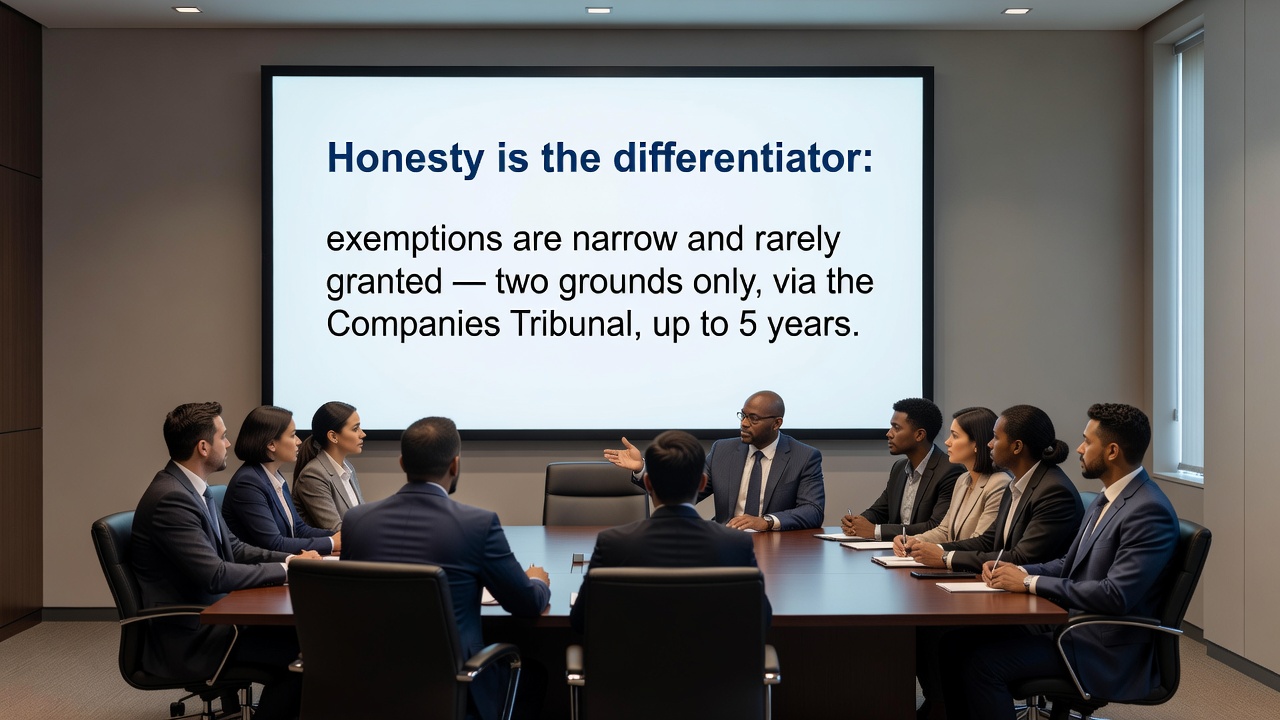
Honesty is the differentiator: exemptions are narrow and rarely granted — two grounds only, via the Companies Tribunal, up to 5 years.
The Legal Reality of SEC Exemption
If you lead a South African organisation with 50 or more employees, you may have wondered whether you can sidestep the requirement to establish a Social and Ethics Committee (SEC). The short answer: probably not. But it's worth understanding why—and what actually applies to you.
The Companies Act 71 of 2008 permits exemption from the SEC obligation in only two narrow circumstances. A company may apply to the Companies Tribunal for relief on either of these grounds alone:
- Another formal committee performs the same functions: Such as an audit, risk, or sustainability committee already performs substantially the same functions as an SEC.
- Public interest necessity: An SEC is not reasonably necessary in the public interest, given the company's particular activities, size, or financial condition.
If granted, the exemption lasts up to five years. After that period, the company must reapply.
This is not a loophole. The Companies Tribunal's test is strict, and most companies that hope for relief do not qualify. The tribunal has consistently held that existing committees rarely perform the SEC's full mandate—which spans ethics, governance, stakeholder engagement, and social and environmental accountability—without significant structural change.
Why Most Exemption Bids Fail
The burden of proof rests with the applicant. You must demonstrate, with documented evidence, that your alternative arrangement serves the public interest as effectively as a dedicated committee would. Regulators and tribunal members have seen many applications that misread the breadth of SEC responsibilities or overstate the reach of a general audit or risk committee.
The second ground (public interest necessity) is even harder to satisfy. A company would need to show that its activities are so low-risk or tightly regulated by another body that an SEC adds no value. Retail, manufacturing, professional services, and financial firms have found this argument particularly difficult to sustain.
Understanding these challenges is crucial as you consider your organisation's whistleblowing and governance obligations, which often intersect with SEC requirements.
What You Are Legally Required to Do Instead
If you do not qualify for exemption—and statistics suggest the vast majority do not—you are bound by the SEC mandate in the Companies Act. The committee must meet regularly, maintain independence, and oversee ethics, stakeholder relations, social development, and environmental stewardship.
If your organisation also operates in the European Union or handles data or employees within EU member states, you are separately bound by the EU Whistleblowing Directive 2019/1937. This requires:
- Internal reporting channel (Article 8): Organisations with 50 or more employees must establish an internal reporting channel—a secure way for workers and contractors to report breaches of EU law confidentially.
- Feedback and acknowledgement (Article 9): You must acknowledge receipt of a report within seven days and provide substantive feedback within three months.
However, it is crucial to note that the directive binds you only through your national transposition. If you operate primarily in South Africa, your legal obligations flow from the Companies Act and South African common law. EU requirements apply only where your operations or workforce fall within EU jurisdiction. For detailed regulatory guidance, consult our comprehensive whistleblowing regulatory guide for the UK, EU, and South Africa.
From Exemption Hope to Compliance Reality
The impulse to seek exemption is understandable: committee governance takes time and resource. But exemption is the exception, not the option. What matters far more is running an SEC—or your internal ethics and reporting infrastructure—properly.
A robust SEC, backed by credible confidential reporting channels and real investigation capability, does more than satisfy legal duty. It catches risks early, protects culture, and builds trust with regulators and stakeholders.
If you are uncertain whether your organisation might genuinely qualify for exemption, the first step is to run through the two grounds honestly. Do you have another committee that truly performs the SEC's full scope? And can you genuinely argue that an SEC is not in the public interest given who you are and what you do?
For most organisations with 50 or more employees, the answer to both is no. That is not a problem—it is clarity. From there, the real work begins: designing an SEC or ethics function that actually works. For practical guidance, review our whistleblowing compliance checklist to ensure your governance structure is complete.
Frequently Asked Questions
Can a company combine its audit committee with an SEC to qualify for exemption?
Technically, yes—but only if the combined committee genuinely performs all SEC functions. The Companies Tribunal requires substantial evidence that ethics oversight, stakeholder engagement, social development, and environmental stewardship are all actively addressed. Most audit committees fail this test because their primary mandate is financial compliance, not broader social responsibility. Exemption is granted in fewer than one in ten such cases.
How long does a Companies Tribunal exemption decision take?
There is no fixed timeline. Applications typically take 2–6 months to reach a decision, depending on the complexity of the case, the quality of supporting evidence, and tribunal workload. During this period, the company remains bound by the SEC requirement. It is wise to assume the exemption will not be granted and maintain full SEC operations in parallel.
What happens if we receive an exemption and then breach it?
Breaching the conditions of an exemption—for example, by allowing the substitute committee to fall below the required standard—leaves the company open to regulatory action, potential director liability, and automatic revocation of the exemption. The company would then be subject to a full SEC requirement, often with retrospective penalties.
Do exemptions apply to state-owned enterprises (SOEs) or public companies?
No. State-owned enterprises and public companies are excluded from exemption altogether. They must establish and maintain a Social and Ethics Committee regardless of size or operational profile. This is a non-negotiable requirement under the Companies Act.
Can we apply for a second exemption after the first five-year term expires?
Yes, a company may reapply after five years, but the tribunal applies the same rigorous test. There is no automatic renewal. Circumstances must demonstrably remain unchanged (or improve), and the applicant must again prove that exemption serves the public interest. In practice, second applications are also rare.
Next Steps
If you would like to assess your organisation's SEC readiness or explore whether your current governance structure aligns with legal requirements, Xono's readiness assessment is a practical starting point. We can help you map your current position, identify gaps, and plan a credible path forward—whether that is establishing an SEC for the first time or strengthening the one you have.
Contact our team to discuss your readiness for compliance.
Ready to Strengthen Your SEC Governance?
Discover whether your organisation qualifies for exemption or needs to establish a compliant Social and Ethics Committee.
Book a Demo Start Free Trial